Ozempic (Semaglutide) for Obesity and Type 2 Diabetes
High-yield Ozempic semaglutide notes for weight loss: GLP-1 mechanism, dosing, Wegovy comparison, STEP trials, side effects, warnings, and clinical pearls.
 Medicine Study Notes
A focused gallery for medical notes, diagrams, handwritten study images, and clinical learning material.
Search calculators by name, keyword, formula, or reference. Each calculator opens separately and has its own inputs, formula, meta title, meta description, and references.
Tap any calculator below to open it.
Fluid plan and maximum allowable blood loss calculator.
Hour 1
0
Hour 2
0
Hour 3
0
Maintenance fluid: 4-2-1 rule: first 10 kg x 4 ml/kg/hr, next 10 kg x 2 ml/kg/hr, remaining weight x 1 ml/kg/hr.
NPO deficit: maintenance rate x NPO hours minus fluid already given.
Intra-op plan: Hour 1 = half deficit + stress fluid, Hour 2 = quarter deficit + stress fluid, Hour 3 = stress fluid.
MABL: EBV x weight x (Initial Hb - Target Hb) / Initial Hb.
Estimated ETT size, ETT depth, LMA and i-gel size.
ETT Size
-
ETT Depth
-
i-gel
-
LMA
-
Type
-
Check
Clinical
Pediatric ETT: cuffed ETT ID = age / 4 + 3.5 mm. Adult estimate: male 8.0 mm, female 7.5 mm.
ETT depth: pediatric oral depth = age / 2 + 12 cm. Adult estimate: male 23 cm, female 21 cm.
i-gel and LMA: selected by weight bands. Always confirm with leak, ventilation, capnography and clinical fit.
Calculate ml/hr from dose, weight and drug concentration.
Dose/hr
0
Conc/ml
0
Weight
0 kg
Step 1: Weight is converted to kg if entered in pounds.
Step 2: Concentration is converted to mcg/ml, mg/ml or units/ml depending on selected dose type.
Step 3: Dose is converted to dose per hour. Weight-based doses are multiplied by patient weight.
Formula: ml/hr = total required dose per hour / concentration per ml.
Common weight-based anesthesia drug dose list.
Each dose is calculated as: weight x dose factor.
These are common reference ranges or typical doses, not a prescription. Adjust for age, ASA status, comorbidities, hemodynamics, renal/hepatic disease, pregnancy, frailty and institutional policy.
Local anesthetic maximum dose and maximum volume estimation.
Maximum dose: weight x maximum recommended mg/kg dose x risk factor.
Maximum volume: maximum mg / drug concentration in mg/ml.
Use the lowest effective dose. Toxicity may still occur below calculated maximums, especially after intravascular injection or in high-risk patients.
Preoperative physical status classification.
ASA Physical Status is a categorical classification based on systemic disease burden. It is not a numeric mortality prediction model.
PACU recovery score for discharge readiness.
Five domains are scored from 0 to 2: activity, respiration, circulation, consciousness and oxygen saturation.
Postoperative nausea and vomiting risk prediction.
One point is assigned for each predictor: female sex, nonsmoker, history of PONV/motion sickness, and planned postoperative opioids.
Obstructive sleep apnea screening tool.
Each positive STOP-BANG item scores 1 point.
Airway view classification.
This is an anatomical classification based on visible oropharyngeal structures with mouth open and tongue protruded.
4-2-1 hourly and daily maintenance fluid.
Daily
2640 ml/day
First 10 kg
40
Extra
70
Uses the 4-2-1 rule for hourly maintenance fluid requirement.
Manual drip rate in drops per minute.
Manual drip rate depends on total volume, infusion time and drop factor of the IV set.
Predicted body weight and lung protective tidal volume.
6 ml/kg
396 ml
7 ml/kg
462 ml
8 ml/kg
528 ml
Predicted body weight is calculated from sex and height, then tidal volume targets are calculated in ml/kg PBW.
Richmond Agitation-Sedation Scale.
RASS is a clinical ordinal scale from +4 to -5 based on agitation, alertness and response to voice/physical stimulation.
Perioperative cardiac risk score.
One point is assigned for each of six predictors.
Simplified surgical VTE risk estimation.
This simplified implementation adds points for common Caprini variables. It does not include every original Caprini item.
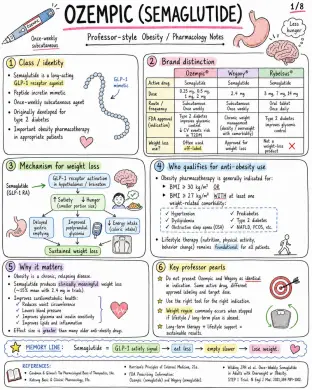
High-yield Ozempic semaglutide notes for weight loss: GLP-1 mechanism, dosing, Wegovy comparison, STEP trials, side effects, warnings, and clinical pearls.
Have feedback, want to report content, or have a topic request? We'd love to hear from you!
Request removal of content - Send us a direct message with the post link and reason
Request new topic notes - Share the topic you'd like to see covered
General feedback - Let us know how we can improve